 VISITORS'
GALLERY
VISITORS'
GALLERY
The pages where other people's Hofners are featured.
HOFNER GUITARS: 2000 to Present Day
With Many Thanks to Nate Lamy of Hofner Canada for his invaluable assistance with the details provided in this Gallery.
NOTE: FOR HOFNER "CT", "ICON", & "IGNITION" GUITARS CLICK HERE
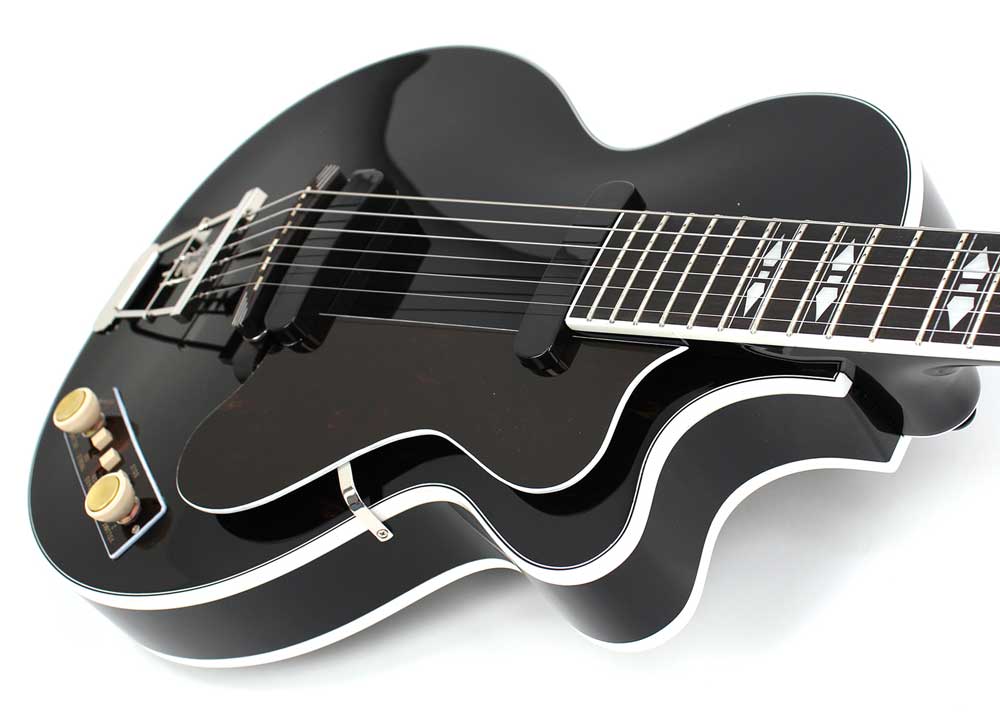
2019 Hofner Club 60 John McNally Model
The current range of Hofner guitars and basses is very impressive and compares well against the old favourites of the 1950's and 60's. Indeed, the style and feel of these new instruments is very much the same as those sold earlier by the Hofner Company, but in fact the overall quality is even better; so much so that I personally own several post-2000 guitars and basses. Never let anyone tell you that the old ones are the best.......that is definitely not true!
I have come to the conclusion that the history of the 21st
century guitars and basses has the same rights as the earlier models to be documented,
so...........here goes!
Click on the underlined heading for each guitar to view photographs of
that particular example.
A. FULL-BODIED ARCHTOP JAZZ GUITARS:
THE HOFNER JAZZICA / J5 (1989 to 2008)
In 1991, a Jazzica Special model was introduced which, being a blonde finish, was provided with binding around the rear body edge. (The original Jazzica had no binding on the body back, presumably as this would not have fitted in aesthetically with the dark gloss finishes chosen for it and the overall style of the guitar.)
The Jazzica Custom model is a development of the Jazzica Special, with rear body binding, floating Hofner pickup, ornate headstock design, and blonde, occasionally brown sunburst, and violin varnish finishes on offer.
A 24-fret fingerboard has been used on the Jazzica throughout its production run. Soundhole plugs were supplied with all models in order to reduce feedback at high amplified volumes.
The Jazzica was not present in Hofner Catalogues after 2008, but don't be surprised if it
keeps reappearing in the future........
- c1990
HOFNER JAZZICA CATALOGUE SCAN
This scan shows two of the gorgeous finish options available when the Jazzica was first introduced, and also the tapering body.
- 1991
HOFNER JAZZICA
A very special example, as this one has been signed-off on the body label by Klaus Sch�ller himself. It was made to special order for Toni Denjer in Germany, and this again is recorded on the body label. The finish is turquoise sunburst, which really does suit the original flamboyant Jazzica design concept. Another design feature evident on the first Jazzica version is the heavily rounded neck heel, which is demonstrated on this particular guitar. I have to say that the early Jazzica design is a great personal favourite of mine! Owned by Alan Cramp in England.
- 1993
HOFNER JAZZICA
The same version of Jazzica as the one above, but this particular guitar has the red sunburst finish. Note the lack of rear body binding on the earlier Jazzicas. Now owned by Ray Land in Edinburgh, Scotland.
- c1994
HOFNER JAZZICA SPECIAL
The differences between the Special and the original Jazzica are pretty obvious with regard to the body and squared-off neck heel treatment. However, the Special still retains the stylish gold-plated ABM tailpiece and the Shadow pickup. Note the clear finished maple headstock.
- 1999 HOFNER JAZZICA
SPECIAL
Some great photos of a Jazzica Special in Natural finish, kindly provided by The Twelfth Fret, Toronto, Canada.
- c2001
HOFNER JAZZICA CUSTOM CATALOGUE SCAN
By around the year 2000, Hofner had stopped using mock-abalone purfling and standardized on a w/b/w/b/w binding/purfling layout. They had also changed from the gold-plated ABM tailpiece to a new and unique ebony-capped type. In addition, the instrument had acquired kerfing where the top & back plates met the rims, allowing Hofner to use thinner laminates for the rims.
This scan shows the blonde finish version of the Jazzica. A Hofner/Schaller pickup is now fitted. The headstock now has a black fascia with double diamond inlay.
- 2003
HOFNER JAZZICA CUSTOM
The last version of the Jazzica, by way of comparison with the early versions above. This one has the less common sunburst finish, and is owned by Les Piggin in Yorkshire, England. Hofner soon discontinued the sunburst finish and introduced a limited run of violin varnish-finished Jazzicas.
Yet another change for the headstock - this time to Hofner's "lillies-of-the-valley" design. From about 2001, Hofner had standardised their archtop headstocks to this design, and stopped using the "double diamond" and "dagger" inlays.
- 2003 HOFNER JAZZICA CUSTOM
.......and a 2003 guitar in the more usual blonde finish.
- c2007 HOFNER JAZZICA
CUSTOM
Some nice pictures of a Jazzica that has recently been worked on by John Moriarty, Dublin, Ireland. This particular example has black body & neck edge binding.
By 2007, some Jazzicas were made with black binding. Some of these were natural finish, and some had a darker violin finish. The soundhole binding was all black instead of black/white.
Also by the mid-2000's, Hofner had made some other small changes to the decoration of the Jazzica Custom - the trussrod cover was changed from plastic to ebony, and the guitar had become slightly shallower in depth at the neck joint.
- c2007 HOFNER JAZZICA
CUSTOM
....and an example of a violin varnish finished Jazzica of 2007. This displays the same black binding to body, neck and soundholes as the 2007 one above.
- 2010 HOFNER JAZZICA - SPECIAL ORDER
This is a one-off special order Jazzica that has two body-mounted pickups, and is finished in the non-standard violin varnish which makes the white binding fitted to this particular special look gorgeous! Otherwise, it has all the features of the Jazzica model, including a solid carved spruce top and those soundhole plugs of course!
- 2012 HOFNER JAZZICA - YELLOW TRIAL FINISH
A Jazzica that was given a special finish as a trial for the possible future option of a yellow finish on other Hofner's archtops and semis. Before seeing the photographs, I would never have believed that bright yellow could look so good on a Jazzica!
- 2010 HOFNER JAZZICA - SPECIAL ORDER
THE HOFNER NEW PRESIDENT / P55 (1998 - Present Day)
Initially the model was fitted with a 24 fret neck. Examples made since around 2006 have 22 frets.
- 1998 HOFNER NEW PRESIDENT
- CATALOGUE SCAN
The first examples of the New President were fitted with a single volume control mounted on the ebony pickguard. A gold-plated "Lyre" tailpiece was fitted and the classic Hofner design based on the "fleur-de-lis" was purfled into the back of the guitar's body.....similar to that on the old Committee/468 model.
- 1999 HOFNER NEW PRESIDENT
- NATURAL FINISH
A nice example of the first type of New Verythin as described above, without a tone control and still with the gold-plated Lyre tailpiece.
- 2001 HOFNER NEW PRESIDENT - CATALOGUE SCAN
By about 2000, Hofner had added a tone control to the New President's pickguard. The tailpiece was changed from the gold-plated "Lyre" type to a new and unique ebony-capped design. They also dropped the elaborate floral purfling from the base of the guitar's body back. In line with their other archtops, Hofner had standardised their archtop headstocks to the "lillies-of-the-valley" design, and stopped using the "double diamond" and "dagger" inlays.
At about the same time, the two struts under the carved spruce top was changed to only one strut. However, the instrument acquired kerfing where the top and back plates met the rims, thus allowing Hofner to use thinner laminates for the rims.
The link leads to a catalogue scan which shows the second version of the New President - blonde finish and still with a 24 fret fingerboard.
- 2001/02 HOFNER NEW PRESIDENT VINTAGE
This example was on display at the January 2002 NAMM Show in California, and is actually the first New President to have the "Antique Violin" finish, which was introduced to many of Hofner's archtops and semis as a catalogue option in 2003. It was probably also one of the first Hofner guitars to be fitted with ebony tuner buttons. The finish was much redder than latter production guitars, and it displays the "fleur-de-lis" inlay on the back of the guitar body, which was typical of the early New Presidents.
- 2004 HOFNER NEW PRESIDENT
A lovely blonde New President. By around 2004, Hofner had made some small changes to the decoration of the New President, with the trussrod cover now changed from plastic to ebony.
- 2005 HOFNER NEW PRESIDENT
In addition to the natural finish, Hofner introduced a limited run of violin varnish-finished New Presidents. The first of these had a very red, antiqued finish, which was replaced by a mid-brown finish. Later versions had darker finishes. The example on the linked page has the former, and is owned by Bob Bullock. This guitar still has 24 frets.
- 2008 HOFNER NEW PRESIDENT
.
By 2007, some New Presidents were made with black binding. Some of these were natural finish, and some had a darker violin finish. Hofner also changed the shape of the New President's ebony pickguard from one with rounded contours to a more sharply angled design with a more pronounced bevel at the edges.
This is a good quality image from a Hofner publicity shoot of a later natural finish example. Note the 22 fret fingerboard that is currently adopted with this model
- 2001 HOFNER NEW PRESIDENT - CATALOGUE SCAN
- 2011 HOFNER NEW PRESIDENT
The New President appeared in the 2011 catalogue with strip-type fret-markers rather than the blocks that had been used previously. The linked page shows the high resolution images used for that catalogue.
THE HOFNER VICE PRESIDENT (1998 to 2003)
The Vice President appeared in 1998, at the same time as the New President model's introduction. It had an identical body to the President model, i.e. full-depth, fully acoustic with a solid carved spruce top and flamed Anigree (African Maple) back & sides. However, it had nickel-plated fittings instead of the gold-plated ones on the New President, although some Vice-Presidents were sold with gold-plated parts. Two Schaller mini-humbucking pickups were fitted. The neck pickup was fitted in the same way as on the New President, but the bridge unit was mounted directly onto the body top, along with the two volume controls, two tone controls, and a three-way switch. A nickel "Lyre-Style" tailpiece and a conventional plastic pickguard were fitted. From around 2002, the lovely genuine mother-of-pearl block inlays found on the early Vice President model's ebony fingerboard were replaced by double and triple position dots on a rosewood fingerboard, and the slotted fret-wire saddle bridge replaced the initially carved saddle bridge. Finish options offered were initially sunburst and black. In effect, the Vice President harked back to the days when Hofner, together with all the other major manufacturers, produced their Jazz guitars with plenty of electrical gear screwed directly onto the body tops.
- 2001 HOFNER VICE PRESIDENT
- CATALOGUE SCAN
One of the early versions, with the mother of pearl block fret markers and carved saddle bridge. It would appear that the very first Vice Presidents had the Hofner "fleur de lys" purfling on the body back, but this example doesn't have that unfortunately.
- c2002 HOFNER VICE PRESIDENT
A slightly later example, with a slotted fret-wire saddle type bridge, but still with the pearl block markers on the fingerboard. Photos kindly supplied by The Twelfth Fret, Toronto, Canada.
- 2003 HOFNER VICE PRESIDENT
- CATALOGUE SCAN
A later Vice President, with the dot fret markers and the slotted fret-wire saddle type bridge.
THE HOFNER PRESIDENT CUSTOM (2011)
A limited edition range of electric archtops that followed the trend of the Vice President model in harking back to the old President model supplied to Selmer London back in the 1950's and 1960's. All versions had a spruce top and birds eye maple back & sides. The highest spec'd version had the large "frondose" headstock as used on the Committee, Deluxe, and Golden models of the past, with mother of pearl block fret-board markers. The intermediate spec had a normal sized headstock but still with the block fret markers. The final version was to have a small headstock and dot fret markers, but it is not known if any of these were actually produced.
- 2011 HOFNER PRESIDENT CUSTOM - LARGE
FRONDOSE HEADSTOCK
- 2011 HOFNER PRESIDENT CUSTOM - LARGE
FRONDOSE HEADSTOCK
- 2011 HOFNER PRESIDENT CUSTOM -
NORMAL-SIZE HEADSTOCK
- 2011 HOFNER PRESIDENT CUSTOM - NORMAL-SIZE HEADSTOCK
THE HOFNER PRESIDENT SPECIALS - LIMITED EDITIONS (2011 - Present Day)
In line with Hofner's policy of producing "Custom Shop" style instruments at Hagenau, these limited edition models based on the 1950/60's Presidents and perhaps the 21st Century Vice Presidents, have provided some very attractive and desirable guitars.
-
2011 HOFNER PRESIDENT CUSTOM - LIMITED
EDITION FINISHES
A limited edition run of guitars with custom finishes and strip-type fret markers was produced in late 2011.
- 2011 HOFNER PRESIDENT SPECIAL
A President without sound-holes and with birds-eye maple back & sides. The body binding is a luxurious white pearloid, and a Bigsby unit and twin "Blade" pickups are fitted. This particular guitar just oozes "vintage Hofner"!
Another set of photos of the Eucalyptus bodied President, this time Hofner's own publicity shots. The guitar features a solid carved spruce top to its 16" wide body.
Back to 1965! As well as the Florentine cutaway this model also has a five-piece (and in a few examples a seven-piece) laminated neck. That is a feature not seen on a Hofner archtop since the 1970's.
THE HOFNER CHANCELLOR (2004 - Present Day)
Hofner's top-of-the-range archtop, utilising all-solid timbers in the body construction - solid carved spruce top and solid flamed maple back & sides. (The Chancellor is the first and only archtop guitar in the history of Hofner to be built with carved top, carved back, and solid rims.) The body itself is a large 17" in width with a high-waisted design shape, a very open cutaway, and elongated F-holes. As with the other recent Hofner jazz guitars, the neck meets the body at the 16th fret. An ebony fingerboard with 22 frets is used, and all metal parts are gold plated. There are additional and thinner layers of white and black purfling on the top and back of the body, as well as on the rims.
Standard finishes throughout the construction period have been violin-varnish (shellac) and natural blonde, although one or two special finishes have also been supplied more recently on a one-off basis. Initial Chancellors were supplied with a simple carved ebony bridge, but currently the guitars are provided with both a tune-o-matic style steel saddle Schaller bridge and with the carved type.
Prototypes of this model appeared at the various trade shows in 2004, with production examples being available by 2005. Whilst the two prototype instruments had the same cosmetic appointments as the New President, production models used a more angled pickguard similar to that introduced on later New President guitars. In 2007, this was replaced with a new design unique to the Chancellor.
Initially, production Chancellors were fitted with beech binding. Then a group of violin finish Chancellors was fitted with black binding and a reddish-burst violin finish. Following that, a group of violin finish Chancellors was fitted with beech binding and a much lighter brownish violin finish. It appears that each group of Chancellors produced to date has its own unique finish.
- 2003/04 HOFNER
CHANCELLOR
Actually a prototype guitar in Violin Varnish which was shown at the 2004 NAMM Show. Also shown was a 24-fret prototype, which was was subsequently not proceeded with. Photos by Nate Lamy.
- 2005 HOFNER
CHANCELLOR
A blonde example owned by Nate Lamy. Also in the photos is the 2003/04 24-fret prototype referred to above.
- 2006 HOFNER
CHANCELLOR
A violin-varnish guitar owned by Giovanni Ghiazza in Italy. Giovanni has also provided a comparison of the Chancellor with his 1962 Golden Hofner.
- 2007 HOFNER CHANCELLOR
An example finished in a highly polished dark violin varnish. This guitar has black binding to the body as well as to the neck. Photos courtesy of Nate Lamy, Canada.
- 2008 HOFNER CHANCELLOR
Good quality Hofner publicity photo of a natural finish Chancellor.
- 2009 HOFNER CHANCELLOR - SPECIAL BLACK FINISH
A special one-off order. Photos taken in the Hofner workshops.
- 2009 HOFNER CHANCELLOR - SPECIAL BLUE FINISH
Another special order, with photos taken in the spray-booth of the workshops.
- 2011 HOFNER CHANCELLOR
In the 2011 Hofner catalogue, the Chancellor is shown without fret-markers, leaving just a plain ebony fingerboard. The linked page shows the high resolution images used for that catalogue. - 2007 HOFNER CHANCELLOR
THE HOFNER CHANCELLOR CUSTOM (2011)
In 2010/11, Hofner prepared four Chancellor guitars for showing at the April 2011 Frankfurt Trade Show. These had all the constructional attributes of the usual Chancellors - all solid carved timber body construction, ebony fingerboard, mother of pearl inlays, etc - but they were fitted with two humbucking pickups directly mounted onto the body top. In addition, the opportunity was taken to finish them in the solid colours used on some of the other Hofner models during this period: i.e. white, black, green, and orange. This choice of finish has lead to the production of very striking instruments, particularly IMHO the white and black versions which are fitted with gold-plated hardware.
- 2011 HOFNER CHANCELLOR CUSTOM - WHITE
& BLACK FINISHES
These two guitars both have gold plated-hardware.
- 2011 HOFNER CHANCELLOR CUSTOM - GREEN
& ORANGE FINISHES
Nickel-plated hardware seems to suit the green and orange finishes better than gold.
THE HOFNER NEW COMMITTEE (2012 - Present Day)
Produced during Hofner's 125th Anniversary Year for introduction at the
March 2012 Frankfurt Musikmesse, these guitars are not intended to be
accurate replicas/re-issues of the 1950/60's favourites. Rather, they have
been designed in the spirit of the old Committees, with large 18" bodies,
laminated spruce tops, highly figured laminated flame maple back and sides,
an ebony fingerboard, and
lots of white pearloid binding. The jigs and press moulds used for the
1963 Committee have been used to make these new versions.
It is good to see that the F-holes also are
bound, just like the old days!
- 2012 HOFNER NEW COMMITTEE
One of the first New Committees to be made, and used as a prototype for photo-shoot purposes.
- 2015 HOFNER NEW
COMMITTEE - SPECIAL EDITION
In 2015, Hofner made six guitars as a special edition of the New Committee for a commission from Swee Lee, their distributor in Singapore. These were finished in a very striking dark vintage sunburst and fitted with accurate re-productions of the old 1960's Escutcheon tailpiece, specially hand-made for this project.
B. THIN-LINE & SEMI ACOUSTIC ARCHED TOP GUITARS
THE HOFNER "JIMMY BRUNO" SIGNATURE (2004)
An archtop guitar named after American Jazz guitarist Jimmy Bruno. This model was developed in 2003 and 2004 to be issued as a very limited run, but was never rolled out because Jimmy chose to move to Sadowsky guitars for an endorsed line. Hofner examples are consequently very rare.
The guitar was essentially a New President with a shallower 2 ½" body side depth, violin finish, 22 frets instead of 24 frets, and body-mounted volume and tone controls. A small ebony pickguard, similar to that used on Benedetto guitars, was added.
Several prototypes were built, half being fitted with Hofner's floating mini-humbucking pickups, and half with full-sized set-in humbuckers. A single "Jimmy Bruno"-branded Seymour Duncan pickup was fitted in the neck position on some of these. The rest had Hofner-branded full-sized humbuckers made by Schaller.
Most examples in existence have carved tops with Hofner's standard single brace on the bass side. As the project moved forward, Hofner added bracing to at least one of these instruments. Knob placement varied slightly as well.
- 2003 HOFNER JIMMY BRUNO THINLINE ARCHTOP
This particular guitar is the first prototype, built for Jimmy Bruno's personal use and evaluation. It was used by him for about a year. Initially it was fitted with one of Jimmy's own pickups. It was later fitted with the Seymour Duncan unit with the Jimmy Bruno logo that is seen in the photos. This guitar had a carved spruce top with laminated back and sides.
- 2004 HOFNER JIMMY BRUNO
THINLINE ARCHTOP
The second of the production run, limited to 50 units. This has a floating Hofner mini-humbucker fitted, which was used prior to "Jimmy Bruno" inscribed units becoming available. It would not have been fitted with a sustain block. Pictures supplied courtesy of Elderly Instruments, Lansing, Michigan, who sold this guitar when new.
- 2004
HOFNER JIMMY BRUNO SEMI-ACOUSTIC ARCHTOP
An example of the last version of the "Jimmy Bruno" model with laminated body top, solid spruce sustain block, and a Hofner full-size (set-in) humbucker pickup.
THE HOFNER THIN PRESIDENT (2004 to Present Day)
The Thin President guitars took over from the Vice President model in 2004. Several major changes to style and basic specification have been made, (actually resulting in four different models but all using the same name), and these are described in the examples given below:- 2004 HOFNER THIN
PRESIDENT - STYLE 1
Initially, the Thin President had a similar appearance to the Vice President model that it superseded, apart from it having the shallower body depth of 60mm (2�") as proposed for the Jimmy Bruno model. It also still retained a solid carved top.
Two pickups and conventional controls were mounted directly onto the body top, a Lyre-style tailpiece and plastic pickguard were fitted, and the fret-location markers were double and triple dots. Sunburst seems to have been the only finish offered.
- 2004 HOFNER THIN
PRESIDENT - STYLE 1
........and Hofner top quality publicity photos.
- 2004 HOFNER THIN
PRESIDENT - STYLE 2
Similar bodies and fittings to the Style 1 above - carved tops and a fully hollow body, but now with a 22 fret neck, ebony fingerboard, and block mother of pearl fret-markers. This style seems to have lasted for only a few months before being replaced by the Style 3 below. Style 2 appears to have been a transition between Style 1 and Style 3.
- 2005 HOFNER THIN PRESIDENT - STYLE
3
A radical change took place in 2005, when the Thin President changed into a single pickup guitar, although the electrics were still mounted directly onto the now laminated spruce body top. Ebony tailpiece and pickguard, plus mother of pearl block fretboard inlays were adopted, giving the guitar a similar appearance at first glance to the New President. However, this guitar now had a sustain block and thinner body (50mm/2" ??), which together with the body mounted electrics made it a very different animal to the New President. Rather strangely, this version was available only in Violin Varnish finish. Comparisons between this version of the Thin President and the last versions of the Jimmy Bruno model described above are inevitable, particularly bearing in mind the timing of its introduction.
- 2007 HOFNER THIN PRESIDENT - STYLE
4
The Thin President was restored to two-pickup status in 2007, and at the same time given a shallower body depth of 42mm (1¾"). The same Lyre-style tailpiece, plastic pickguard, and mother of pearl block fret markers of the first Thin President version were restored, and a Bigsby vibrato tailpiece with roller bridge was also offered as an option. A sustain-block was fitted to the body, and a natural blonde was the standard finish.
- 2009 HOFNER THIN PRESIDENTS - STYLE
5 (Initial Production Guitars)
A similar specified guitar to Style 4 including the 42mm body depth, but finished in solid and very bold colours, which has the effect of totally transforming the model! These dramatic guitars began to appear in 2009. A Bigsby vibrato tailpiece is a standard fixture on many of these guitars, which fits in perfectly with the rockabilly style of the guitar. Solid colours available were white, light blue, peppermint green, ruby red, and black.
- 2010 HOFNER THIN
PRESIDENT - STYLE 5
A beautiful white guitar, with gold plating and Lyre tailpiece. Photo courtesy of Cream City Music, Milwaukee, USA,
- 2010 HOFNER THIN
PRESIDENT - STYLE 5
....and a similar one but this time in a very smart solid black finish. Photos courtesy of Cream City Music, Milwaukee, USA, -
2015 HOFNER THIN
PRESIDENT (HTP-E2) - STYLE 5
The same formula as previous, but with a Bigsby vibrato tailpiece and without the block fret markers. Available in black or ivory options.
THE HOFNER "MODEL 457" 12-STRING ELECTRIC ARCHTOP (2017-2018)
A guitar which harks back to the 19760's Hofner Model 457/12, but updated for modern sounds and technology. This low-production model appears to have been based very much on the above Thin President Style 4 model, with laminated spruce top, and flame maple back and rims. A spruce center block was fitted, which allowed the use of the stud-tailpiece and a mounting for the twin humbucking pickups. Schaller mini-tuners were fitted to the elongated headstock. Available in Tobacco Sunburst and Natural finishes.
THE HOFNER CHANCELLOR THINLINE
This guitar is not a standard production item, but at least one has been made as a special order. Really, it was a fore-runner of the type of "Custom Shop" guitars that Hofner have now started producing at Hagenau in their "Gold Label" Range.
2012 HOFNER THINLINE CHANCELLOR SPECIAL ORDER - IVORY FINISH
A guitar with stunning looks and a large 17" wide thinline body. Solid spruce body top with solid maple back and sides. The neck is one piece maple with an ebony fingerboard with no fret-markers. Equipped with two "Hofner "Staple" pickups mounted directly onto the body and conventional volume, tone, and pickup selector switch. The chrome hardware and black binding compliments the ivory finish perfectly.
THE HOFNER VERYTHIN (2000 to Present Day)
Just as with the Thin President above, several different styles of the Verythin model have been available since it superseded the Hofner Nightingale in 2000. It was intended to be a modern-day revival of the famous 1960's and 70's Hofner Verithin/4575 model. (The name had to be changed very slightly from Ver"I"thin to Ver"Y"thin for copyright reasons.)
The most important features of the Verythin are the twin body cutaways, and the very thin 30mm (1�") body depth. Unlike the old Verithins, the 21st century version has a solid sustain block inside the body, which of course makes the guitar now a true semi-acoustic.
This is not the first time that Hofner has revived the Verithin, however. The Hofner T2S, T4S and T6S,
which were produced in the late 1970's and into the 1980's, were essentially
updated Verithins (and are great guitars by the way!). They were replaced by the Nightingale
in 1986.
THE VERYTHIN CLASSIC (2000 to 2010; 2018 to Present Day)
The first version to be rolled-out was the "Classic". This guitar was well specified, with an ebony fingerboard, inlaid with mother of pearl block fret markers, and gold hardware. A laminated spruce top with heavily figured anigree (African Maple) back and sides was shown off to best advantage by the standard natural finish, and in the old Verithin tradition, a Lyre tailpiece was used. In a break from convention however, "slash-shaped" soundholes were used, a design feature borrowed from the Jazzica. The scale length was 25.5".
Electrics at first glance appear to be conventional - four rotary controls plus three-way pickup selector, but Hofner chose to incorporate their "Clean Contour" effect worked by the tone controls for each pickup, as had been pioneered on the superseded Nightingale model. This allows for a single coil or twin coil sound on each pickup. Hofner's mini-humbucker (Type 514) was fitted throughout the Classic's production period. The 514 unit is made exclusively for Hofner by Schaller.
The first Verythin Classics came with 24 fret necks but very soon after, the specification changed to a 22 fret neck. The very first production guitars did not have the "Clean Contour" effect, and had a simpler w/b/w binding/purfling scheme on the face of the guitar and single white binding on the neck. The specification was quickly changed to w/b/w/b/w on the face, and w/b/w on the neck. The first guitars came with "teacup" knobs, which were changed to standard Gibson-style amber top-hat knobs. Early Verythin Classics had "double diamond" headstock inlays. By 2002, Hofner had standardized its headstock overlays on all models to the lilies-of-the-valley inlay and stopped using the "double-diamond" and "dagger" inlays.
Around 2006, Hofner slightly increased the depth of the neck set on the Verythin Classic, and began sinking the pickup mounting rings slightly into the body of the guitar to allow for a greater range of pickup height adjustment They also replaced the Schaller roller bridge with a Schaller tune-o-matic bridge.
The Classic was offered in natural and sunburst finish. Natural is by far the most common finish, and the sunburst option was discontinued during 2002, and re-introduced in 2009. Four or five Verythin Classics were produced in black finish as well between 2000 and 2002. A limited run of Verythin Classics were offered with a violin varnish for a short period.
Production of the first series of Verythin Classics ceased in 2010. A second series was introduced in 2018, fitted with pickups without covers and dot fret-markers instead of the previous MoP blocks.
- 2000 HOFNER VERYTHIN CLASSIC
This 2001 Hofner catalogue photo shows the "double diamond" headstock logo, "tea cup" knobs, and the 24 fret neck of the very first Verythin Classics produced.
- 2000 HOFNER VERYTHIN CLASSIC - NATURAL FINISH
The first production Verythin Classic, which was signed off in the Hofner workshops on 4th January 2000. The guitar has had a few changes made to it over the years, in particular the ebony bridge base and control knobs, but it still demonstrates the main features of a very early Classic. This is actually the very same guitar as shown in the catalogue photo above!
- 2001 HOFNER VERYTHIN CLASSIC - SUNBURST FINISH
The alternative finish to the more usual natural blonde on the Classic. The "double diamond" headstock logo is still present, but the control knobs are now the Gibson-style gold type.
- c2001 HOFNER VERYTHIN CLASSIC - BLACK FINISH
Catalogue-style artwork showing one of the very rare black finished Verythin Classics. This particular guitar has a non-standard inlaid ebony bridge base-plate for some unexplained reason.
- 2003 HOFNER VERYTHIN CLASSIC - NATURAL FINISH
A later Verythin Classic, more typical of the majority of Classics made, with a 22 fret neck, "lilies-of-the-valley" headstock detail, and gold Gibson-style knobs. My own guitar, with its natural blonde finish and gold-plated hardware.
- 2009 HOFNER VERYTHIN CLASSIC - SUNBURST FINISH
A Hofner publicity photo showing the brunette finish that became an option again on the Classic in 2009.
- 2010 HOFNER VERYTHIN CLASSIC - SUNBURST FINISH
This could well be the last Series 1Verythin Classic to be made (October 2010). This one is a real stunner, with beautiful flame evident on the body back and neck, together with ebony tuner buttons and truss-rod cover.
- 2018 HOFNER VERYTHIN CLASSIC (ii) - NATURAL FINISH
Dot fret-markers instead of blocks, the covers left off the pickups, and the "Clean Contour" electrics now removed. Still with the spruce top, the gold plating, the "Lyre" tailpiece, and the classy slash-shaped soundholes though.
THE VERYTHIN VINTAGE (2001 to 2003)
The "Vintage" was basically a "Classic", but was equipped with the traditional Hofner rectangular control console, and also was finished in Antique Violin Varnish. The Vintage was therefore the first Hofner model to be so finished, with Violin Varnish being adopted for the archtops over the next few years. The three slide switches on the console were on-off for each of the two pickups, plus a series/parallel switch for the neck pickup.
The Vintage was replaced by the Verythin "JS Signature" in 2003/04.
- 2002 HOFNER VERYTHIN VINTAGE
Olaf Poeter's lovely Hofner Verythin Vintage.
THE VERYTHIN STANDARD (2002 to 2008; 2018 to Present Day)
A more affordable version of the Verythin was brought out in 2002. The "Standard" dispensed with the gold plating and used nickel-plated hardware, and was also fitted with a 22 fret rosewood fingerboard with simple double dot fret-markers. Single layer binding was applied throughout. However, the adoption of highly figured anigre (African maple) for the body top (instead of the Classic's rather conservative spruce) as well as the back & sides, together with stunning transparent amber and cherry finishes possibly made this the most attractive of the Verythin versions. In addition, a stop tailpiece was used instead of the Lyre-style; again moving further away from the 1960's look.
Conventional, unbound f-holes similar to those on the New President were used. These revealed the use of a very thin laminated top on the instrument, thinner that the spruce-laminated top on the Verythin Classic. The scale length was 25.5" and Gibson-style "top-hat" knobs were used.
The electrics on the Standard were initially two mini-humbuckers (Type 514), but around 2006, these were changed to Hofner's full-size humbuckers (Type 515) to provide an even more traditional US-semi look. The "Clean Contour" circuit provided on the Classic was not fitted to the Standard.
The second version of the Verythin Standard was made in very limited quantities. The fingerboard had single dots with triple dots at the twelfth fret. The solid spruce block was replaced with a solid mahogany block. Hofner slightly increased the depth of the neck set much as they had on the Verythin Classic. The guitar was available in a natural finish (called by Hofner "Amber" because anigree often has a darker colour than the maple of the neck), and a transparent red (which was more tomato than cherry). A few were ordered with sunburst finish.
Small Limited-Edition versions were produced in 2012/13, but the "Standard" finally re-appeared in the 2018 Hofner main catalogue. It was now offered with a lightish-brown sunburst finish as standard,
- 2001 HOFNER VERYTHIN STANDARD PROTOTYPE
The photo of this prototype was taken in November 2001, just before the new "Standard" version of the Verythin was announced in the following year. It would appear that at that stage, Hofner were still considering equipping the Standard with a Lyre tailpiece, just as had been the case with the "Classic" and "Vintage". Also on the linked photo page is a picture of Dieter Fischer examining the guitar. This was used in the 2003 Hofner Catalogue.
- 2002 HOFNER VERYTHIN STANDARD
A Transparent Amber finish "Standard", courtesy of Bill Heggie in Scotland. The mini-humbuckers and the double/triple fret marker dots of the earlier Standards can be seen.
- 2003 HOFNER VERYTHIN STANDARD
....and a Transparent Cherry Red finish guitar, again courtesy of Bill Heggie.
- 2006 HOFNER VERYTHIN STANDARD
A photo of one of the later Standards, showing the full-size humbuckers and the single/triple fret marker dots. This one is owned by Nate Lamy in Canada.
- 2006 HOFNER VERYTHIN STANDARD
Another of Nate's guitars, this time with black pickup surrounds, control knobs, and selector switch tip.
- 2007 HOFNER VERYTHIN STANDARD - SPECIAL RED FINISH
A custom semi-transparent red finish was used on this particular guitar.
- 2008 HOFNER VERYTHIN STANDARD - SPECIAL BLACK FINISH
A mirror-like black finish, with special gold-plated hardware.
- 2012 HOFNER VERYTHIN EUCALYPTUS BODY - LIMITED EDITION
Based on the Verythin Standard format, but a one-off limited edition of ten guitars, with stunning smoked-eucalyptus back and sides. Binding is white pearloid, and an ebony fingerboard with no fret markers is fitted to the one-piece maple neck. This guitar model is a sister to the Eucalyptus-backed President shown above; both being produced to celebrate the Hofner Company's 125 year anniversary.
- 2013 HOFNER VERYTHIN AMBER - LIMITED EDITION
A one-off limited edition of twelve guitar, also based on the earlier Verythin Standard format but fitted with special "Classic Standard" pickups designed by Wolfgang Damm of the Amber Pickup Company. The guitar itself is finished amber using thin nitrocellulose lacquer.
- 2018 HOFNER VERYTHIN STANDARD
The resurrected Standard, in its light-brown sunburst finish.
THE VERYTHIN "JS" SIGNATURE (2003 to 2010)
Named after Jazz Guitarist and Hofner endorsee, John Stowell, this guitar took over the violin varnish crusade from the Verythin Classic. However, the "JS" is a single pickup guitar, with ebony pickguard, tailpiece, control knobs, and tuner buttons. The Type 514 mini-humbucker is fitted in the neck position and controlled by a single volume and tone control mounted on the body top. Early versions have the pickup mounted directly onto the top of the guitar and later versions have the pickup floating, mounted off the end of the neck.
The "JS" has gold-plated hardware, ebony fingerboard, and mother of pearl fret-marker inlays, and is also available in natural finish as well as the shellac varnish. Simplicity combined with quality is the order of the day with this guitar.
- 2003 HOFNER VERYTHIN "JS" MODEL
A violin varnish "JS", originally owned by Paul Carrack before being stolen in 2003.
- 2006 HOFNER VERYTHIN "JS" MODEL
A natural finish "JS" from a Hofner publicity shoot.
THE VERYTHIN EVOLUTION 3 (2009 - 2010)
Hofner's three-pickup Verythin, produced for a short period in 2009 and 2010 as a reminder of the three-pickup Hofner 4575 model produced in the late 1960's and early 1970's. The Classic's main features were adopted, without the gold-plating, and the three mini-humbuckers were controlled by a master volume rotary control, two tone controls, and a three-way pickup selector. Each tone control has a centre notch (position 5), with conventional control over the bridge and neck pickups taking place from 1 to 5, with blending in of the middle pickup occurring between 5 to 10.A lovely rich brown sunburst was the standard finish. Pearloid buttons on the tuners of the production guitars seem to have replaced the metal buttons of the early examples.
This guitar was replaced by the similar three-pickup Verythin "Custom" in the 2010 catalogue.
- 2009 HOFNER VERYTHIN EVOLUTION 3 (Hofner Publicity Photo)
- 2009 HOFNER VERYTHIN EVOLUTION 3
- 2010 HOFNER VERYTHIN EVOLUTION 3 (with Hofner-fitted Bigsby)
THE VERYTHIN CUSTOM (2010 to 2013)
This guitar is very similar to the Evolution 3 described above, but with "sickle" style soundholes, reminiscent of those on the 1950's Hofner 459 and 464 models, together with simple dot markers instead of the Evolution's mother of pearl blocks. However, it has a slightly shorter scale length of 24.7".
THE VERYTHIN SPECIAL (2010 to 2016)
Again, a slightly less ornate Verythin as an alternative to the previous Classic. Simple dot markers and nickel-plated hardware replace the MoP block fret markers and gold-plating. However, the Special has the retro "sickle" soundholes, an ebony fingerboard, and also a master volume control in addition to the individual pickup volume and tone controls. The scale length is 24.7", and available finishes for the Special are Dark Cherry and Sunburst.
THE VERYTHIN SINGLECUT (2010 to 2016)
This guitar harks back to the 1960's Hofner 4562......a single cutaway 30mm deep body! However, this new model has a Bigsby vibrato unit fitted as part of the standard specification, an ebony fingerboard, "sickle" soundholes, and Hofner's new solid colour finishes. The scale length is 24.7". The Singlecut was initially available in either solid black finish or light blue. From 2011, a transparent red finish replaced the solid black.
In 2015, Hofner changed the traditional "Bell-flower" headstock design to the 1980's style "Double-diamond". A light green finish became available at the same time.
2010 HOFNER VERYTHIN SINGLECUT - SOLID BLACK & LIGHT BLUE FINISHES
2012 HOFNER VERYTHIN SINGLE CUT - TRANSPARENT RED FINISH
2015 HOFNER VERYTHIN SINGLE CUT - LIGHT GREEN FINISH
THE VERYTHIN DELUXE CT (2014 to Present Day)
A small-bodied version of the Verythin, with a 14½" wide lower bout measurement instead of the usual 16". The Verythin's standard 24.7" scale length also suits the overall concept of providing an easier guitar to play than the normal semi. Beautiful flame maple veneers are used throughout for the body, which is shown off to perfection by the transparent black finish. This is a "Contemporary Series" Asian-made guitar.
THE VERYTHIN GREENLINE MODEL (2018 to Present Day)
Following on from the success of the 500/1 Greenline Bass introduced in 2017, this Verythin has been developed using the same philosophy. Nearly all plastic has been eliminated and replaced by wood, including the binding, pickguard, control knobs, headstock logo, and pickup surrounds; all of which are made from walnut. The body top is a spruce laminate, with the back and sides of flame maple. Rather than the traditional rosewood fingerboard, a walnut board has been used on a maple neck. Two simple wooden dots are used to indicate the 12th fret on the fingerboard.
The pickups are specially made by a small Bavarian company called NoWaxx.
The aim is to have a guitar the is ecologically friendly and can in many many years time be easily recycled, which is an unusual concept but one that Hofner believe to be right.
2018 HOFNER VERITHIN GREENLINE
THE HOFNER CLUB RE-ISSUES (2007 - Present Day)
2007 was the 120 Year Anniversary of the Hofner Company. In order to commemorate this occasion, the company produced a small number of limited edition models; one of which was a re-issue of the 1959 Hofner Club 40 used by John Lennon in the early days of the Beatles. The re-birth of the Club as a current model had begun!
Numbers of the "John Lennon Club 40" were limited to 120, but these guitars proved to be so popular that Hofner commenced making a two-pickup Club 50 model in 2008, and this model remains in production today. Obviously the John Lennon Club 40 was finished in blonde, as that was the version owned by the man himself. Initially, the Club 50 was only produced in blonde, but from 2010, a brunette version was available. Production has continued on an intermittent "special edition" basis ever since
In 2012, a limited edition single pickup Club 40 was produced, fitted with the single coil "Toaster" pickup.
The guitars have a laminated spruce top with flame maple back & sides. As with the original 1960's Clubs, the body is totally hollow, without a sustain block being fitted.
THE HOFNER CLUB 40 RE-ISSUE (2007, 2012)
- 2007 HOFNER "JOHN LENNON" CLUB 40 RE-ISSUE
Photos of the one shown at the NAMM guitar show in Jan 2007.
- 2012 HOFNER LIMITED EDITION CLUB 40 "TOASTER"
A German-made Club limited edition fitted with a single re-pro "Toaster" pickup. Although this guitar is not intended to be an accurate replica, it does embody the style and spirit of the early 1960's Club 40's.- 2012 HOFNER LIMITED EDITION CLUB 40 "TOASTER"
Photos of the Club shown at the Frankfurt Musikmesse in 2012.
THE HOFNER CLUB 50 RE-ISSUE (2008 to Present Day)
- 2008 HOFNER CLUB 50 RE-ISSUE
The initial blonde finish Club 50 RI, with a black lacquer neck. Photos from a Hofner publicity shoot.
- 2008 HOFNER CLUB 50 RE-ISSUE - PROTOTYPE
A pre-production prototype, fitted with a spruce sustain block in the body.
- 2008 HOFNER CLUB 50 RE-ISSUE - THREE PICKUP SPECIAL ORDER
A one-off special order, with photos taken whilst the guitar was still in the workshop.
- 2010 HOFNER CLUB 50 RE-ISSUE
A brunette finish, introduced at the March 2010 Frankfurt Musikmesse.
- 2015 HOFNER CLUB 50 RE-ISSUE
An example of a special edition production run. This particular guitar is rather unusual as it is fitted with the Hofner Type 511 "Staple" pickups. It also left the workshop without a pickguard. Owned by David Wren in Australia.
THE HOFNER CLUB 60 RE-ISSUE (2019)
-
2019 HOFNER CLUB 60 RE-ISSUE - JOHN McNALLY MODEL
John McNally of The Searchers played a Club 60 during the band's early days when many of their hit records were being produced. Initially, the guitar had a blonde finish, but just before The Searchers found fame John had his Hofner re-finished in gloss black. In later years, John and his black Club became parted.
The guitar in the photo was produced by Hofner in early-2019, especially for John, to replace his long-lost guitar. It is intended that a limited edition of around 9 further John McNally guitars will be completed later in 2019, complete with a pack of rare photos, signed certification, a CD, and more.
HOFNER LEADER GUITARS (2018 - 2019)
Introduced at the end of 2018, these guitars hark back to the 1950's and 60's "Club-Style" guitars, in that they are small-bodied, light-in-weight, but essentially uncomplicated "working" instruments.
There are two Leader models, the Classic and the Professional. Both are fitted with twin pickups specially produced for Hofner by a small Bavarian company called NoWaxx: a single coil fitted adjacent to the neck and a twin coil unit at the bridge. A centre sustain block is fitted in the body, specially designed by Hofner. This allows the pickups and potentiometers to be fitted to the guitar without the need for an access panel in the back of the body.
The Classic is the more expensive model. It has flame
maple throughout which is hand tinted to highlight the flame maple used and
then given a gloss clear topcoat. The body and ebony fingerboard are bound
with spruce. A big 6-a-side headstock has been taken directly from Hofner's
old early 60s solid body guitars such as the set-neck Colorama and V-Solids.
It has a master volume plus a blend knob which allows the pickups to be
easily blended. This blend knob has a centre notch to ensure that, when
required, both are working at 100% output.
The Professional is the cheaper version, with a spruce body top and flame maple back and sides. It's sustain block is mahogany, rather than the spruce of the Classic. The Professional also differs from the Classic version in that it has a traditional Höfner 3-a-side headstock with the Bell-Flower inlay. This version was offered in late-2018 with just one solid colour finish – dark blue with a hint of silver sparkle. A master volume rotary control and a 3-way pickup selector switch control the twin pickups
HOFNER SIGNATURE GUITARS (2013)
In 2013, Hofner made the decision to produce a limited number of "Signature" guitars, based on the requirements of notable artists of the period. Up to that date, only two other signature guitar ranges had been produced by Hofner; the Pohlert range produced in 1979 celebrating the well known German jazz guitarist and music teacher called Werner P�hlert, and the AZ range of archtops and semis produced between 1982 and 1991 and based on the requirements of Attila Zoller.
THE HOFNER JOHNNY FLESH SIGNATURE GUITAR
The first of Hofner's new breed of Signature Guitars, and intended to appeal to Psychobilly bands. This guitar was introduced at the 2013 Frankfurt Show, with appearances by Johnny Flesh (a.k.a. Johann von Fleisch) himself. The guitar is a thin-bodied (2" depth) semi-acoustic fitted with centre sustain block in the 16" wide body. The body has a carved solid spruce top and laminated maple back& sides. Electrics are also conventional, with twin Hofner mini-humbucker "diamond logo" pickups, two volume and one tone rotary controls, and three-way selector switch. Convention then seems to have been thrown out of the window, with the two finishes on offer - black and purple, green binding, a black Bigsby vibrato unit, skull control knobs on the purple version, chicken-head on the black......Oh, and green neon strings!
C. SOLID GUITARS
THE HOFNER "V" SOLID (2011 - 2012)
Fingers crossed, but it would appear that Hofner are considering bringing back a German-made solid guitar into their catalogue! The last solids made in Germany were the Reference Series solids which were discontinued in 1996 when production moved away from Bubenreuth.
THE HOFNER SOLID CLUB (2011)
Another prototype under consideration in 2011, developed following the success of the Chinese-made HCT-CS10 solid guitar. Solid mahogany body, with solid flame maple cap and scraped wood bindings. The "flared-top" headstock is very reminiscent of a certain bass guitar....
THE HOFNER COLORAMA SUPER (2019)
A production guitar, made in Hofner's German workshops, using the original 1956 Hofner 160/162 as the inspiration to produce a stunningly retro design. Two versions are to be made, fitted with either one or two "Toaster" pickups. Solid mahogany is to be used for the body. The neck is one-piece maple, and "rugby ball" tuners as fitted to some 500/1 bases are to used. The bridge is of course fully adjustable, which is a big improvement on the 1956 guitar! Various colour options are to be offered.
2019 HOFNER "COLORAMA SUPER" SOLID GUITAR (PROTOTYPE)
This guitar has a maple body instead of the mahogany intended for production guitars, and three-on-a-plate tuners instead of the proposed "rugby balls"
