Patrick Kirby's account of working at the old Selmer Musical
Instrument
Showrooms, (with a postscript by Simon Croft and memories from Richard Bourne).
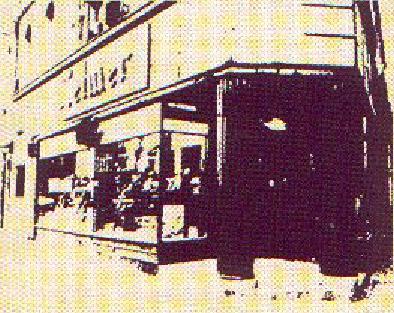
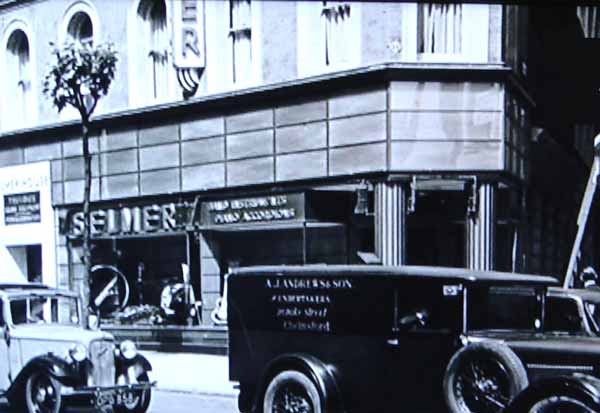
Selmers, 114-116 Charing Cross Road, London in the late-1930s/1940s.
In 1966, at the age of 15 and just out of
short trousers, I naively trawled "Tin Pan Alley", that infamous part
of London W.C.2, in search of a job as trainee recording engineer. This
friendly and trendy artistic community centred around Denmark Street
and encompassed scores of quality music stores, recording studios and
publishers offices.
Its cafes (especially the Gioconda) were frequented by an unlikely mix
of pop stars, session musicians, pluggers and pimps. There must have
been hundreds more like me looking, as I soon figured out that the
chance of getting an engineers job was nigh impossible.
Despite being offered some interesting alternatives, I was lucky enough
to find a job as tea-boy at Selmer Musical Instruments Ltd at their
showrooms on 114-116
Charing Cross Road, London WC2, earning £7 and 10 shillings a
week. I got the job because Paul Kossoff was leaving to form the band
Free. The shop-front to
Selmer's building was quite grand, with tall bronze columns, framing a
dazzling array of Gibson and Fender guitars, Henri Selmer brass and
woodwind instruments, and every other sort of musical item you might
imagine. On entering, there were plush display cabinets lined with red
crushed velvet, as far as you could see, all full of guitars, brass and
woodwind instruments.
The salesmen all had a big smile and were accomplished musicians with a
wealth of experience of the instruments and equipment they sold. Their
opinions were highly regarded by customers. There were four floors of
offices above the showroom, crammed with various administrative
departments. It was the swinging sixties, and the atmosphere was fast
and heady. Selmers was the number one music store with an incredible
reputation world-wide.
On Saturdays, a uniformed Commissionaire stood at the double entrance
doors, giving
Selmer the credibility of a royal palace.
My day began with clocking in, winding up the window -grilles, and
taking breakfast orders from the dozen or so
bleary-eyed salesmen and managers, all shattered by their previous
nights gigs. Those bacon
s'arnies, rum ba-ba`s and hot cappuchinos I ferried from the 101 Bar
opposite seemed to kick-start their day, and I sometimes got to keep
their change! Bands of musicians trundled into the store each day,
showcases were unlocked, and instruments were tried and demonstrated.
If things went well, the grinning salesman would head for the
glass-panelled managers office to negotiate a deal, and the door would
slam. The waiting customer would, within seconds, read facial
expressions within to know if his bid was
successful. A heck of a lot of "wheeling and dealing" went on in those
days, with the purchase of complete outfits for new (and green) bands
was usually negotiated by their managers. Individual musicians would
usually buy on hire-purchase, a draconian system whereby goods could be
re-possessed in a flash if the repayments were not kept up.
A strong-minded man called Mr Lock ran the hire-purchase department. He
would consider any defaulting customer to be a rogue. As the new boy I
had the job of humping (an English expression for lifting!) massive
amounts of
re-possessed equipment up to the top floor of Selmers, where it was
held in limbo pending court proceedings. On the way back down to the
showroom, a fleeting moment caught chatting-up a mini-skirted secretary
could land me in trouble! Even so, the salesmen themselves spent most
of their time jamming together in the store. I felt this was rough
justice until I was elevated to the
position of assistant demonstrator in the plush Organ Salon on the
first floor. This meant that a new "lad" had been taken on.
This most palatial room had red flock wallpaper, elaborate wall and
ceiling mouldings, fake marble columns and massive chandeliers, but
failed to impress the mainly teenage customers who came looking for
groovy keyboards and wah-wah pedals. It did seem to please our aging
directors though, its decor resembling a sort of time-warp back to the
dance band era that they were so proud of. Selmers was incarnated by
Lou Stone, a famous band leader in the 1940`s. His pictures adorned the
staircase leading from showroom to organ salon.
My
colleague in the Organ Salon was an unlikely chap called Ted Woodman,
who was totally sold on Art Tatum. When I first saw Ted playing Jazz on
organ I feared he was having an epileptic fit, or was on drugs....his
eyes rolling as he writhed his arms over the keyboards, twisting and
turning his legs across the massive 32 note pedalboard, swinging his
head around dangerously. Soon after, having seen Alan Haven on TV with
the Beatles, doing exactly the same thing, I quickly picked up the art
and with the encouragement of a guy called John Bell, who ran the drum
department (and was rather nifty with the skins himself), we were out
playing jazz gigs in dodgy Soho clip-joints most nights, earning on
average 10 shillings each a session. (then fondly known as
half-a-knicker). John and I used to beg and borrow keyboards from the
store for gigs, but eventually saved up and bought a second-hand Lowrey
Heritage organ from Selmers. I discovered some of the words to a
Sergeant Pepper song written on the polished wooden top, and thought
this was sacrilege until I found out from John that this was the organ
that Selmers used to hire to EMI, Abbey Road!
In the store, each instrument had a sales tag, with the buying-in price
represented as a code "CHEAP RINGS" (1-10). This was invaluable for the
salesman negotiating a keen deal. Unfortunately though, many regulars
got to know the code!
Regarding the competition at that time, Macari Musical Instruments were
just down Charing Cross Road, selling Vox products. It was a small
scruffy corner shop. Drum City was later set up on Shaftsbury Avenue
(Ginger Baker was often found jamming there) and Sound City was located
opposite, being managed by Dave Wilkinson, brother of Tommy who worked
for Selmers. Later there were two new
music showrooms opened behind Centrepoint, on St Giles Circus, selling
Burns Guitars and Hammond organs. There were no instrument shops on
Denmark Street then as there are now, just publishers and demo studios
like Pan Sound.
I have so many happy recollections of those times, and of the big names
that we used to serve at Selmer: The Shadows, The Beatles &
Mal Evans, Peter Green, The Who, The Tremolos, Bob Dylan & The
Band, Graham Bond, Procul Harum, Cat Stevens, The Kinks, Waren
Mitchell, (a fine clarinet player better known as Alf Garnett), Debbie
Harry, Mud, Ginger Baker/Cream, Pink Floyd, Gerry & the
Pacemakers and many more, as well as many major classical and foreign
artistes. For Bob Dylan`s, The Band, appearing at the legendary Isle of
Wight Music Festival, Selmer engineers took weeks customising a Lowrey
H25 console organ. The result was the most amazing set of sounds you`ve
ever heard.
And any serious guitarist around in those days will remember the
infamous "Dick", guitar repairer extraordinaire, who was to be found in
his cluttered little workshop in the basement. Together with salesman
and outstanding guitarist Jerry Donohue, Dick re-designed the Fender
Stratocaster and Telecaster many times over, with Fender themselves
graciously acknowledging the considerable tonal improvements. Next door
to Dick was a happy pair of brass and woodwind repairers, Laurie and
Albert. The big classic sixties sound relied heavily on brass
instruments, and their considerable skills, kept everyone working.
Further along the basement
corridor was a quiet-spoken Italian called Nando. He spent most of his
time tinkering with the old accordions. There was always a big pile of
squeeze-boxes in pieces behind him, and
I'm still unsure as to whether this reflected success or not!
In those days the volume of repairs coming into Selmers workshops was
vast, and sales were at an all-time high. The whole operation was run
with utmost precision by a happy, dedicated team of people who really
loved their jobs.
I started working for Selmers around the Truvoice/Grey crocodile era,
and left around the grey/silver speaker-cloth era. The basic designs
never changed much, with mainly cosmetic changes to fascias and badges.
Selmer always tried to emulate Fender circuitry and cabinet
styles. The most popular kit was the Treble `n` Bass 50 amp,
usually sold with 2 4x12 column speakers and a Shure 545 switched
mike. Thunderbird Amps(with spring reverb and chrome swivel stands) used to sell
like hotcakes, as well as the round edge
Goliath 2 x 18" Bass
cabinets The later amp/speaker combination with
in-built Leslie rotary
speaker & spring reverb unit was a great
success with guitarists, and was often hired by EMI for The Beatles
when recording at Abbey Road.
Selmer amps and speakers were very well built and
incredibly reliable, especially given the abuse they were often
subjected to by 60`s-70`s bands. I myself used a Selmer Stereomaster Amp
for many years, which consisted of two separate amps with
"Selectortone" push button pre-sets. A friend of mine still gigs with
this very amp to this day, and it has never let him down. I guess this
is fair testimony to the Selmer brand.
Around the time that Jerry
Donaghue was selling gear at Selmers, a guy called Dave Reeves came in
with a prototype "Hi-Watt" amp top and 4 x 12 lead cabinet, that he had
apparently made in his shed. Jerry and his
colleagues tried it out and was amazed with the sound quality. Not long
after, we started selling considerable amounts of Hi-Watt products at
Selmers, much to the consternation of our bosses. This I guess was the
start of the demise of Selmer amps. The truth was that the Hi-Watt
range were superbly built, looked good, and sounded really incredible.
The Selmer factory was in Theobalds Road, WC2, a building that was
previously a London County Council school supplies depot. It was a vast
place, and all Selmer amps and speakers were manufactured there. (ED.
- Click HERE
for Allan Baldwin's account of working in the Selmer amplifier factory)
Lowrey Organs were assembled from American kits there, though the
cabinets were mostly made in the UK. I remember a guy called Dave
Brandon,
who's job it was to test the amps before despatch. He was a stunning
guitarist, able to play bass, chords and solo all at the same time. He
loved his Meazzi tape Echo Unit. Binson was of course the top echo unit
then, using a metal disc instead of a tape loop. Selmer were then sole
importers of Gibson & Fender products, Hofner, Henri Selmer
Paris, Lowrey Keyboards, Elka-Orla Keyboards, and Selmer first brought
Yamaha products into the UK, and later the first Meazzi electronic
drum-kits.
The factory later moved to
Braintree, Essex, and some of us were given the option to re-locate
there. Another division of Selmer was Selcol, also based in Essex, who
used to manufacture white plastic garden products.
SELMER STAFF:
Mr J. A. Cochrane:Chairman &
Managing Director
Phil Cowan:Director
Mr Edwards:Export Dept.
Dave Seville:Trade Sales Dept.
(- now Director of Yamaha UK)
Jack Moore:Director/Store Manager
Brian Lake:Assistant Manager
(- still gigging in Southampton)
John Bell:Drum Dept. (- now
a Headmaster & successful jazz musician)
Ray Smith:Guitar Dept. (-
ex Heads, Hands & Feet, and now living in Wales)
Colin Falconer:Guitar Dept.
(- went to Australia)
Tommy Wilkinson:Guitar Dept.
(- ex Dark Blues, and still selling guitars in London)
Jerry Donahue:Guitar Dept.
(- ex Fotheringay, and now with The Hellecasters)
Mike Chapman:Guitar Dept.
(- writer for The Sweet, Mud, Debbie Harry)
Jack Hawkins:General Sales
Ted Woodman:Keyboard Dept.
Dick Clifton:Guitar Repair Dept.
Willie Fahey:Brass & Woodwind
Dept. (- still gigging in London)
Dave Mowatt:Brass & Woodwind Dept.
Laurie ?? & Albert ??:
Brass & Woodwind Dept.
Nando Fabi:Accordion
Repair Dept. (- became MD of Elka-Orla Musical Instruments, UK)
Dave Lock:Keyboard Repairs Dept.
Dick:Caretaker
Doris:Canteen
June:Typing Pool
I understand that Selmer Musical Instruments Ltd was bought by a U.S.
company in the late 80`s, and never recovered. Selmers was a well-run,
well-respected institution that was the envy of every other music
company in those days. It has bred a multitude of seriously good
musicians and businessmen who have gone on to be very
successful, many of them within the list above.
PATRICK KIRBY
ADDITIONS TO THE ABOVE, COURTESY OF COLIN FALCONER (SEE
SELMER STAFF ABOVE):
"I'd just like to fill in a few missing
details about staff and the Charing Cross Road mob at Selmers.
The guitar repairman's full name is Dick Clifton. Quite a character -
he used to dress up in Wild West outfits and go square dancing in the
evenings. (He had his own drinking mug - on it was written 'My Tea,
Like a Rose' - There used to be an old tune called 'Mighty Like A
Rose'.)
I think Laurie's surname was Fisher, but I wouldn't bet the family
jewels on it."
THE RE-FURBISHMENT OF 114-116 CHARING CROSS ROAD IN 1970
This major event in Selmer's famous retail store
history
was recorded in contemporary editions of "Beat Instrumental":
Beat Instrumental October 1970.
Beat Instrumental September 1970.
POSTSCRIPT ON 114-116, CHARING CROSS ROAD by Simon Croft:
In the mid-to-late 1970's, the
shop was taken over by a company called REW
that sold professional audio gear, but also had a pro-video division
and ran a chain of hi-fi shops in the West End.
My friend Neil worked for REW and he showed me round the shop just
after they'd taken it over. All the glass instrument show cases were
still there,
as were a few guitars, including a rare Gibson Howard Roberts, which
seemed a bit bizarre.
A while later, I left my job as a
bored musical instrument maker and
became an even more bored office equipment salesman. Fortunately, Neil
got me an
interview with REW and I was soon a pro-audio salesman. Just like in
the Selmer days, early responsibilities included going over to
Giaconda's or 101 and
getting in the s'arnies and coffee. I must have done a reasonable job
because a few years later I was running
the entire store! Alas, REW was sold to Thorn EMI, who didn't much care
for pro-audio or West End retail, so they closed the
shops. That was about 1984.
After a spell as a computer shop,
114 Charing Cross Road became The Turnkey
Shop and was again back in audio and musical instruments. In mid 2005,
Turnkey was bought by Sound Control, the UK's largest chain of musical
instrument shops.
So quite a musical history really.
FURTHER MEMORIES from Richard Bourne - A Spoilt Kid and a Famous Cigarette
It was about 1964 when, courtesy
of a local dealer I'd bought a couple of guitars from, I managed to score a
part-time job at 114 Charing Cross Road. I was 16 at the time and, because
I was only there on odd days and half days for a couple of weeks, I really
didn't get to know anyone there very well, although a few of the names on this
site ring distant bells. There were however a couple of memorable
occasions. The first was when I was in the guitar department (replenishing
strings on a shelf from memory) when this affluent looking guy and his son (a
kid a bit younger than me) asked one of the salesmen what the best guitar in the
shop was. Such things are a matter of opinion of course, but to this salesman it
was definitely the Gretsch "White Falcon" - which was also probably the most
expensive guitar in the shop. Without even bothering to look at it, or try
it out, this guy said he'd take it, and paid for it on the spot. The
salesman was obviously a bit stunned, but said how sure he was that the guy
would enjoy playing it, to which the guy replied: "It's not for me. My lad here
wants to learn the guitar, so I thought he should have something decent".
I'm not sure, but I don't think the guy even asked about an amplifier. To
someone like me, who could at least play the guitar more or less, a Gretsch
White Falcon was the impossible dream. The thought of someone getting one
to learn on
was unbelievable!
The second was on my last day
there, when I turned a corner - and bumped into George Harrison, who apologised
with a lop-sided grin. I was 16, and I'd just bumped in to a
Beatle! I
ducked out sight and lit up a cigarette, then heard a scouse voice in my ear:
"Would you have a spare one of those?" I was smoking a brand called
"Piccadilly" at that time, which had a mainly white pack, which I nervously
offered to George, who took a cigarette then whipped a pen from his jacket and
scribbled on the pack before thanking me, handing it back, and moving off.
I looked at the packet, and he'd written "I owe you one ciggie George Harrison."
Over the years, I've probably embellished that story a bit here and there, but
that's basically what happened. I've never been able to find out just what
George was doing in the shop at that time. Maybe it was for a promotion of
some kind - perhaps someone else might remember. All I know is that I kept
that cigarette packet for many years, until it eventually went astray sometime
during my move to Australia in 1978. I wonder what it might be worth now?
FURTHER MUSIC STORES IN LONDON'S WEST END DURING THE EARLY
1960'S - KINDLY PROVIDED BY DON MACKRILL
Pan Music
(above the Wiskie a Gogo), Wardour Street
Billy Amstell's Store, Wardour Street
Take Five, Shaftesbury Avenue,
Rose Morris, Shaftesbury Avenue
Bill Lewington's Store, Shaftesbury
Avenue
Boosey & Hawkes, Denman Street
Chas Foote, Golden Square
Lew Chester's Store, Rupert Street
(later taken over by Ivor Arbiter and run for a while by Bob Adams, a
legend in his own right!)
.jpg)
.jpg)